
 Back
BackReplace Tires by Age, Not Just Damage: Safety Guide (2026)
Many drivers wait for a flat or blowout, but tire aging can quietly reduce grip and braking. Learn when old tires should be inspected or replaced for safety.

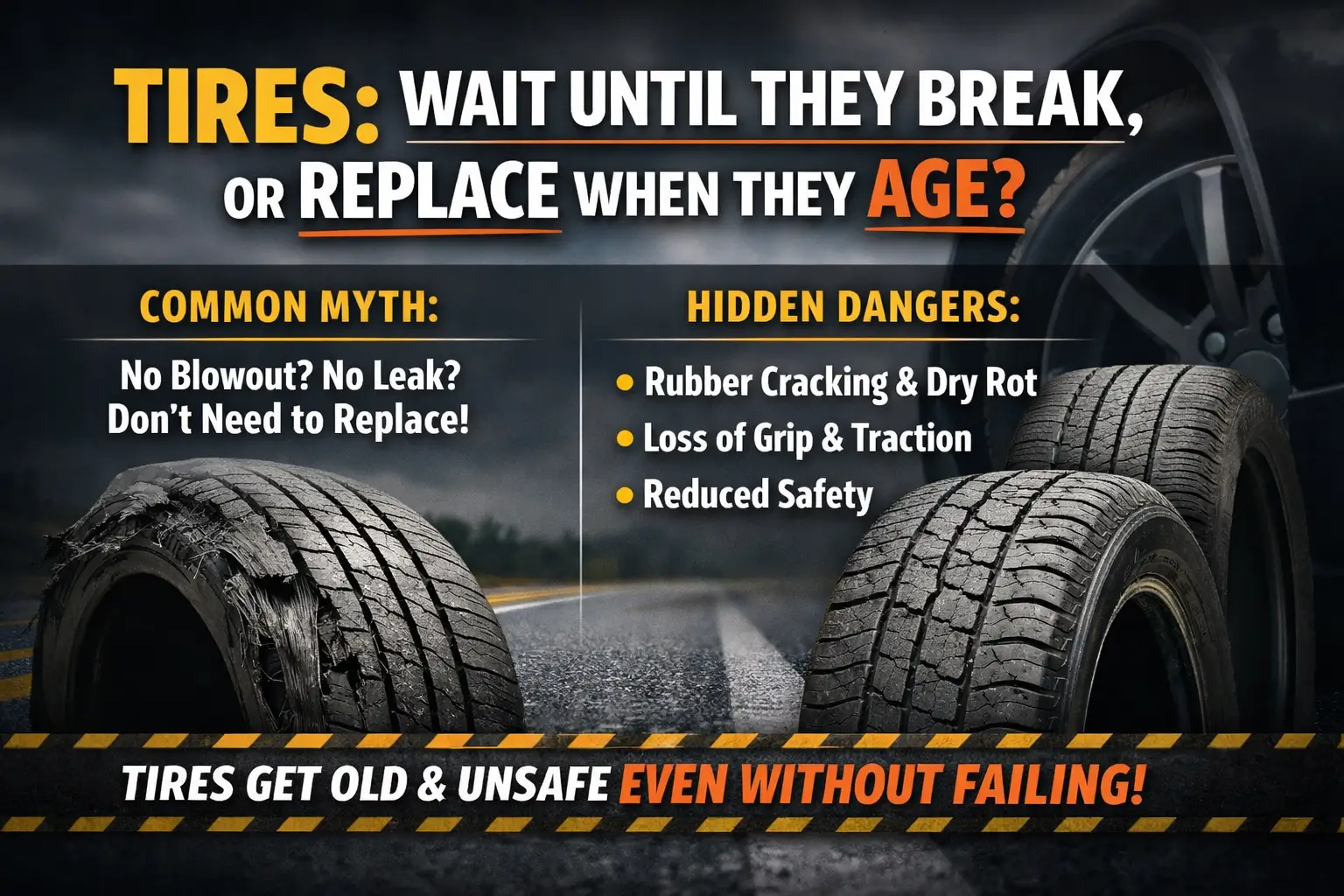
The short answer
Many drivers believe tires only need replacement after a puncture, leak, or blowout. That belief is incomplete. A tire can look "fine" from a distance and still lose grip and braking performance as the rubber ages and hardens over time.
In other words, tire safety is not only about visible failure. Age, storage conditions, heat cycles, inflation habits, and tread depth all matter. That is why "no flat yet" is not a reliable safety test.
Why this matters for safety
- Hidden risk: Aging can be gradual and easy to miss until a wet-road stop or emergency maneuver exposes reduced traction.
- Performance decline: Older, hardened rubber may not conform to the road as well, especially in rain or colder conditions.
- False confidence: Drivers often keep using old tires because there is no obvious damage, even when replacement discussion is already reasonable.
- Hard safety limit still applies: Per NHTSA guidance, tires should be replaced when tread reaches 2/32 inch (1.6 mm), even if there is no puncture history.
Tires are best treated as safety-critical components, not convenience parts.
A simple mental model: "failure" vs "degradation"
Think in two buckets:
- Failure events: puncture, leak, sidewall damage, blowout.
- Degradation trends: aging, hardening, reduced wet grip, longer stopping distances, increasing noise or harshness.
Most drivers only react to bucket 1. Safe maintenance requires you to monitor bucket 2 as well.
Practical checks every driver can do
1. Check tire age from the DOT code
Find the DOT date code on the tire sidewall. The last four digits indicate week and year of manufacture. Example: 2422 means week 24 of 2022.
Age alone does not prove immediate danger, but it is a key signal for increased inspection frequency and replacement planning.
2. Check tread depth, not just appearance
Use a gauge if possible. Replace at 2/32 inch (1.6 mm) in any major groove. A tire can still "look okay" in photos yet be at or near this limit in one area.
3. Monitor pressure consistently
Check cold tire pressure (psi) regularly and follow the vehicle placard. Incorrect pressure can accelerate wear and make aging-related performance decline worse.
4. Pay attention to early behavior changes
If you notice reduced wet confidence, longer braking feel, harsher ride, or new noise/vibration, do not dismiss it as "normal old-car behavior." It may be a tire condition signal.
5. Schedule professional inspection when unsure
A qualified inspection can separate tire-age issues from alignment, suspension, wheel, or inflation problems.
Common myths to correct
- Myth: "If it has not blown out, it is still good."Truth: Blowout is a late-stage failure event, not a preventive maintenance target.
- Myth: "No leak means no problem."Truth: Leakage and grip performance are different issues. A tire can hold air and still provide weaker traction than expected.
- Myth: "Only tread depth matters."Truth: Tread depth is critical, but age and rubber condition also influence safety outcomes.
- Myth: "Old tires are fine for low-mile driving."Truth: Low mileage does not stop rubber aging. Time and environment still affect compound condition.
When age should trigger replacement discussion
Start a serious replacement discussion when one or more of these conditions appears:
- tire age is high and inspections show hardening or cracking signs
- wet braking confidence is noticeably worse
- tread depth is approaching limits in any major groove
- repeated balancing/alignment checks do not restore stable behavior
- a professional inspection identifies condition-related risk
This is not about panic. It is about avoiding the "wait until obvious failure" mindset.
FAQ
Q1: If my tires never went flat, why replace them?
A tire can remain airtight but still lose performance due to aging and hardening. Safety depends on traction and braking performance, not only whether the tire holds pressure.
Q2: What is the non-negotiable tread limit?
Per NHTSA guidance, replace when tread reaches 2/32 inch (1.6 mm) in any major groove.
Q3: Does low annual mileage mean I can ignore tire age?
No. Lower mileage can reduce wear rate, but it does not stop time-related rubber degradation.
Q4: Are all old tires automatically unsafe?
Not automatically. Condition depends on storage, climate, maintenance, and usage. But age increases risk and justifies stricter inspection and earlier replacement planning.
Q5: What should I do first if I am unsure about tire condition?
Check DOT age code, measure tread depth, verify cold pressure, and book a professional tire inspection if anything seems uncertain.
Next steps
If your current tires are older and you are unsure about condition, use this simple order:
- Check DOT age code and tread depth now.
- Correct pressure to placard spec.
- Schedule a professional inspection if signs of degradation are present.
- Plan replacement before emergency performance is compromised.
Safe tire decisions are about prevention, not waiting for failure.