
 Back
Back7 Signs Your Tires Are Aging: Quick Safety Checklist (2026)
Use this simple checklist to spot tire aging early: cracks, bulges, low tread, air loss, noise, weak grip, and steering vibration before safety drops.

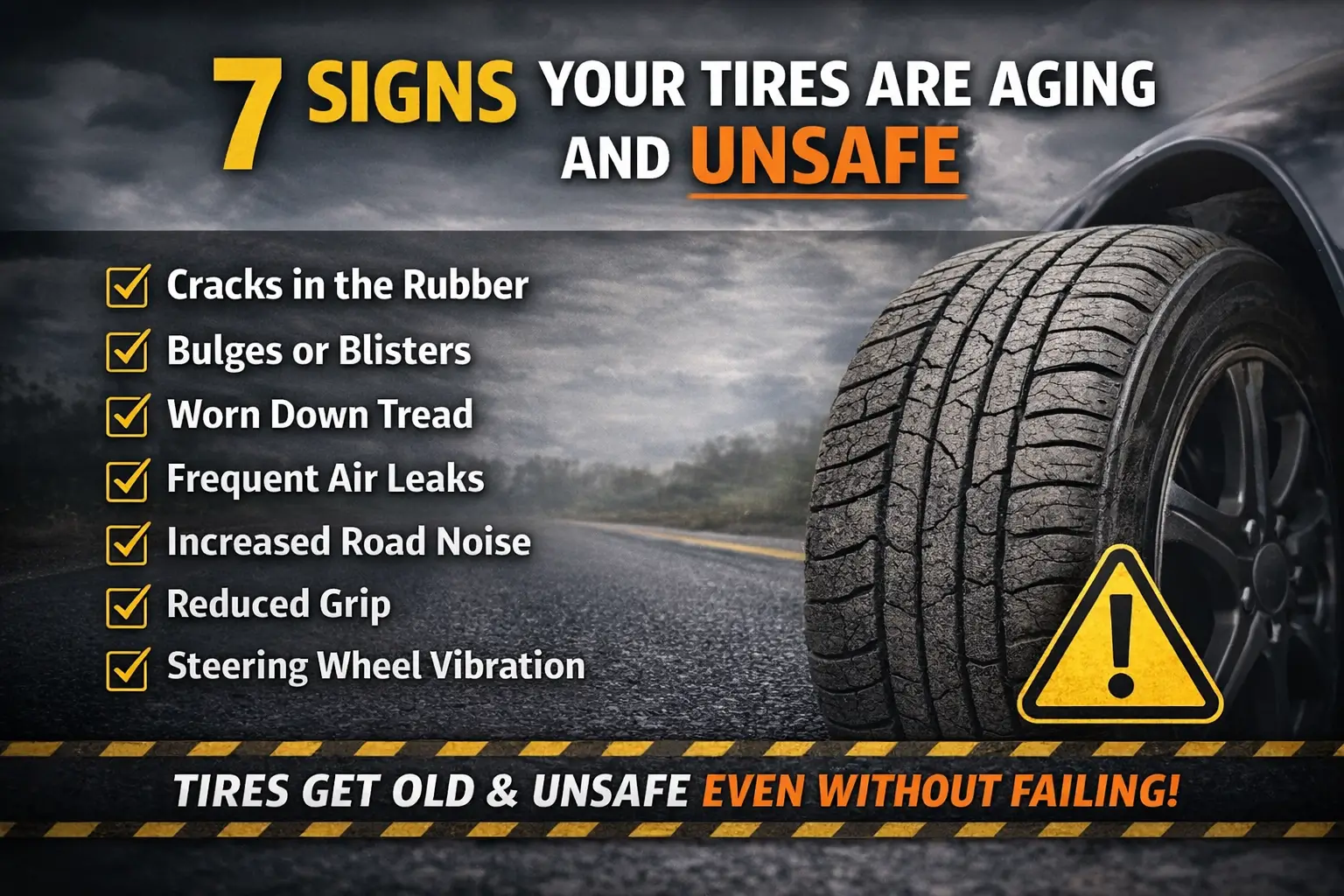
The short answer
If your tires show cracks, bulges, shallow tread, repeated air loss, louder noise, weaker grip, or steering wheel vibration, they may no longer be safe even if they have not gone flat yet.
That is the key mindset shift: tires are safety-critical parts, not "replace only when broken" parts. Aging and hardening can reduce performance before obvious failure appears.
Why this checklist matters
Many drivers wait for a puncture or blowout as a replacement trigger. That is too late in many cases. Tire risk often rises gradually: less traction in rain, longer braking feel, more noise, and unstable steering feedback.
A practical checklist helps non-technical drivers make faster, safer decisions before an emergency exposes the problem.
Quick pre-check before the 7 signs
- Check tire pressure cold (psi) and correct to door-placard spec.
- Check tire age from DOT date code on sidewall (last four digits = week/year).
- Measure tread depth if possible.
Hard threshold: replace tires when any major groove reaches 2/32 inch (1.6 mm) per NHTSA guidance.
The 7 signs your tires are aging
These are warning signals, not perfect diagnosis by themselves. Treat them as "inspect now" flags.
1. Cracks in tread or sidewall
What it can mean: Rubber is aging and losing elasticity.
What to do now:
- Check whether cracks are spreading or deep.
- Avoid high-speed trips until inspected.
- Schedule professional inspection if cracks are visible on multiple tires.
2. Bulges or bubbles on the sidewall
What it can mean: Structural weakness in the sidewall.
What to do now:
- Treat as urgent safety issue.
- Minimize driving and avoid highway speeds.
- Replace/inspect immediately; do not wait for a leak.
3. Tread is too shallow
What it can mean: Reduced wet grip and longer stopping distances.
What to do now:
- Measure tread depth across multiple points.
- Replace at 2/32 inch (1.6 mm) in any major groove.
- If wear is uneven, also check alignment and suspension.
4. Frequent air loss
What it can mean: Slow leaks, bead issues, valve problems, or tire/wheel condition decline.
What to do now:
- Track pressure changes weekly for a short period.
- If one tire repeatedly drops more than others, inspect promptly.
- Do not normalize "always topping up" as routine.
5. Road noise is getting louder
What it can mean: Irregular wear, hardening compound, or balance/suspension contribution.
What to do now:
- Compare noise change over time, not one drive.
- Check tread pattern for scalloping/cupping.
- Get balance, alignment, and tire condition inspected.
6. Grip feels worse than before
What it can mean: Reduced traction from aging rubber or worn tread, especially in rain.
What to do now:
- Pay attention to longer braking feel and corner confidence.
- Reduce speed in wet/cold conditions until checked.
- Plan replacement discussion if grip decline is noticeable.
7. Steering wheel vibration
What it can mean: Possible tire/wheel imbalance, uneven wear, bent wheel, or suspension issues.
What to do now:
- Note when vibration appears (speed range, braking, smooth road).
- Arrange inspection for tires, balance, and suspension components.
- Treat persistent vibration as a safety concern, not just comfort.
Common mistakes to avoid
- "No blowout means still safe." Not reliable.
- "No leak means no issue." Air retention and grip performance are different.
- "Only tread depth matters." Age and condition signals matter too.
- "I do not drive much, so age is irrelevant." Time and environment still age rubber.
FAQ
Q1: If my tire still has tread, can I ignore age?
No. Tread depth is crucial, but aging can still reduce performance before obvious failure.
Q2: Is one warning sign enough to replace immediately?
Not always. Some signs indicate urgent replacement (for example bulges), while others require prompt inspection and risk-based decision.
Q3: What is the fastest home check for non-car people?
Use this order: pressure, DOT date code, tread depth, then the 7 warning signs above.
Q4: What if the tire looks normal but grip feels worse?
Treat behavior changes seriously. Schedule inspection and drive conservatively until cause is confirmed.
Q5: Should I keep driving if steering vibration suddenly appears?
Avoid high-speed driving and inspect soon. Persistent vibration can indicate tire or chassis issues that affect safety.
Next steps
If you see one or more signs, do not panic, but do act quickly:
- Record what you observed and when it happens.
- Check pressure and tread depth.
- Book a tire/alignment/suspension inspection.
- Replace tires before risk escalates.
Helpful reads:
Preventive decisions are safer and usually cheaper than waiting for a failure event.