
 Back
BackWrong Tire Size: What Happens and How to Prevent It
Buying the wrong tire size can cause rubbing, speedometer error, warning lights, and AWD driveline damage. Learn the checks before ordering.

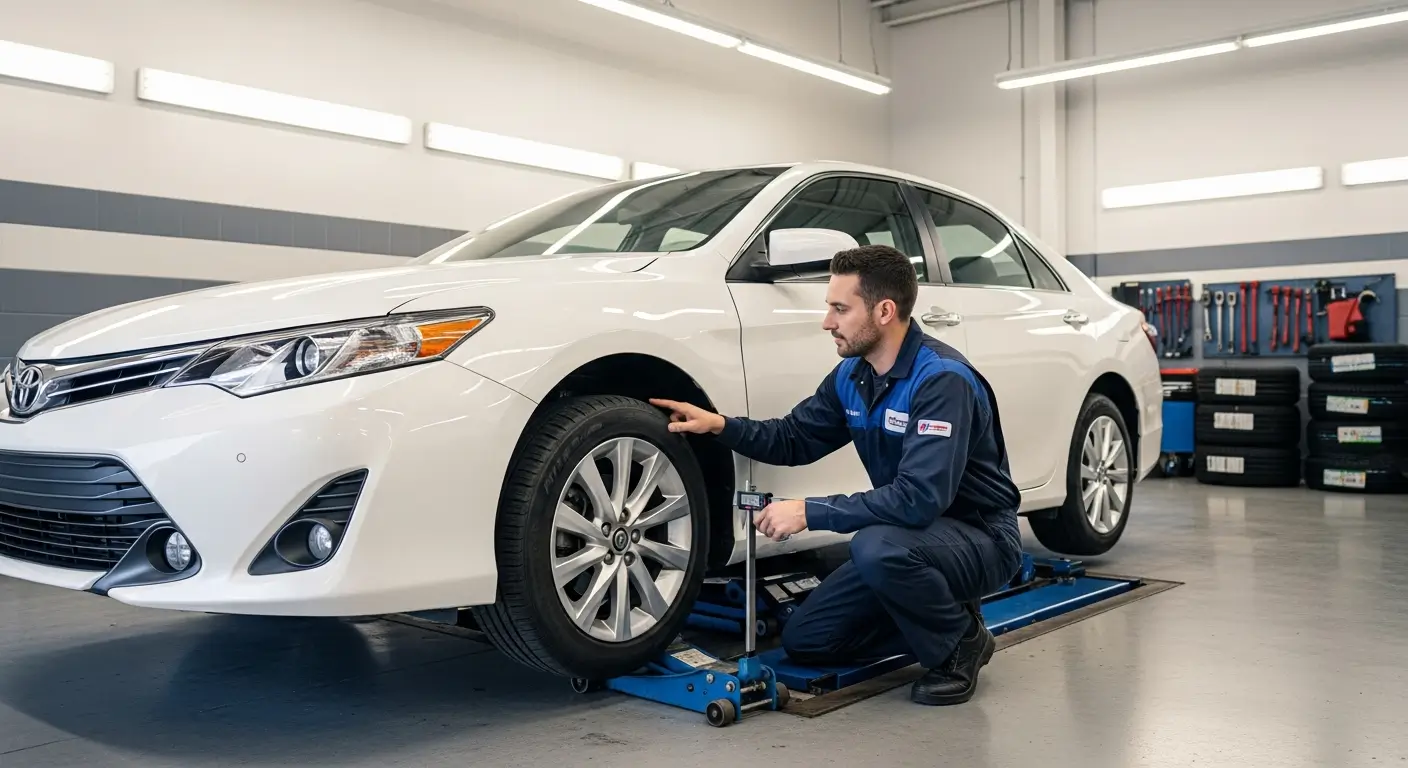
Buying the wrong tire size is not just an annoying return problem. The wrong tire size can rub the body or suspension, distort your speedometer and odometer, trigger warning lights, and in AWD vehicles, put expensive driveline parts under constant stress.
This guide reflects FixGo's hands-on experience operating a Southern California partner network, including 200+ partner shops across greater Los Angeles and 20 partner shops in the San Diego area. Our technical content is reviewed by installation professionals who see these issues firsthand, every day.
TL;DR:
- Start with the tire placard on the driver's door jamb or the owner's manual, then verify the size before you order.
- A tire that is wider, taller, shorter, or lower-rated than specified can affect clearance, electronics, speed readings, and AWD hardware.
- FixGo's Southern California partner network can perform a free 100% fitment check before you commit to a tire order.
What this guide helps you decide
- You bought, or nearly bought, a tire that is one number off from the size on your car.
- You are seeing rubbing, ABS, traction control, stability control, or TPMS warnings after a tire change.
- You drive an AWD car or SUV and need to understand why rolling diameter matching matters.
- You want a practical way to prevent a wrong-size order before a SoCal commute turns into a shop visit.
The plain-language answer
The safest replacement tire is the size listed by the vehicle manufacturer, usually on the Tire and Loading Information Label on the driver's door edge or B-pillar, or in the owner's manual. NHTSA also advises drivers to consult a tire dealer when there is any doubt about the correct size.
That matters because tire size is physical geometry, not just a catalog label. The width affects how close the tire sits to the strut, spring perch, control arm, fender liner, and wheel well edge. The aspect ratio and wheel diameter affect overall tire height, which changes clearance and wheel speed. The load index and speed rating affect whether the tire meets the vehicle's required service description.
If you want a deeper breakdown of what each sidewall number means, start with How to Read Tire Size. If you are still shopping, pair that with How to Choose Tires for Your Car before comparing brands.
How to evaluate it step by step
1. Check the fixed size, not just the wheel diameter
The last number in a tire size, such as the "17" in 225/45R17, is only the wheel diameter. It does not tell you the full tire height. A 225/45R17 and a 225/50R17 both fit a 17-inch wheel, but they do not have the same rolling diameter.
Use this quick formula for a nominal estimate:
overall diameter = wheel diameter + 2 x (section width x aspect ratio / 100 / 25.4)
For a 225/45R17:
- Sidewall height: 225 mm x 0.45 = 101.25 mm, or about 3.99 inches.
- Overall diameter: 17 + 3.99 + 3.99 = about 24.97 inches.
For a 225/50R17:
- Sidewall height: 225 mm x 0.50 = 112.5 mm, or about 4.43 inches.
- Overall diameter: 17 + 4.43 + 4.43 = about 25.86 inches.
That is roughly 3.6% taller. Tire Rack notes that this kind of calculation is nominal, because real tire dimensions vary by manufacturer and model, but the math is still useful for understanding why a one-number mistake can be meaningful.
2. Look for structural rubbing before blaming the tire brand
Fitment rubbing usually shows up in predictable places:
- Inner shoulder contact near the strut, spring perch, or control arm when the tire is too wide or the wheel offset is wrong.
- Outer shoulder contact at the fender lip or liner when the tire is too wide, the car is loaded, or the suspension compresses.
- Front liner or bumper-tab contact at full steering lock when the tire is too tall.
- Intermittent scrape marks after driveway entries, steep parking ramps, speed bumps, or freeway dips.
For Southern California commuters, marginal fitment often appears on repeated compression rather than in a parking lot. A tire may clear while parked in Alhambra, then rub during I-10 expansion joints, I-405 dips, I-15 heat-loaded freeway runs, or a tight parking ramp near downtown LA. If the marks are fresh and repeatable, stop treating it as cosmetic. Rubbing can damage a liner, wear the tire shoulder, or mask a suspension clearance problem.
3. Calculate speedometer and odometer error
Your speedometer is calibrated around the expected tire circumference. If the new tire is taller, it travels farther per revolution, so the vehicle is moving faster than indicated. If the new tire is shorter, the vehicle is moving slower than indicated.
Use this simple estimate:
actual speed = indicated speed x new tire diameter / original tire diameter
Using the 225/45R17 to 225/50R17 example:
65 mph indicated x 25.86 / 24.97 = about 67.3 mph actual
The odometer error follows the same direction. With a tire about 3.6% taller, the odometer under-reports distance by about 3.6%. Over 10,000 real miles, the odometer would record roughly 9,640 miles. With a shorter tire, it over-reports. That affects fuel-economy math, service intervals, lease mileage tracking, and how quickly you think the tire is wearing.
4. Pay attention to ABS, traction control, stability control, and TPMS lights
Modern vehicles use wheel-speed information for more than the speedometer. ABS, traction control, stability control, and indirect TPMS logic may compare wheel-speed signals. A wrong-size tire can make one corner or axle appear to rotate at a different speed during straight-line driving.
That does not mean every warning light after a tire change is caused by size. Low pressure, a damaged sensor, a relearn issue, or a genuine system fault can also trigger warnings. NHTSA notes that TPMS may use sensors in the tires or wheel speed and other vehicle sensors, and a TPMS symbol means tire pressure should be checked promptly. Start with cold pressure from the vehicle placard, then confirm that all four tires match the approved size unless the vehicle was designed for a staggered setup.
For pressure basics, see Tire Inflation Pressure Safety.
5. Treat AWD rolling diameter mismatch as a high-risk issue
AWD systems are especially sensitive because the driveline expects tire rolling diameters to stay matched according to the vehicle manufacturer's guidance. If one tire is taller, shorter, newer, or more worn than the others, the wheels can rotate at slightly different speeds even when the car is going straight.
Depending on the vehicle, that constant mismatch can stress clutch packs, center differentials, viscous couplings, transfer cases, or electronically controlled AWD components. The problem is not usually one dramatic event. It is heat and load accumulating every mile.
Do not rely on a universal internet tolerance. Some manufacturers allow only very small differences in circumference or tread depth; others specify replacing all four tires together or using a tire shaved to match the remaining set. Follow the owner's manual or the manufacturer's tire replacement guidance for your specific AWD model.
Practical recommendations
Best everyday value: EngineX DuraGuard HP
For daily sedans and compact commuters using compatible sizes, the ENGINEX DURAGUARD HP 205/55R16 91V is the first EngineX option to consider in this approved set. It is a budget-friendly everyday alternative for drivers who want reliable commuting performance without chasing a premium-brand name for normal school, work, and freeway use.
The fitment rule still comes first: only choose it if 205/55R16 91V matches your vehicle's required size, load index, and speed rating. EngineX tire products are 100% covered by Road Hazard protection, but Road Hazard coverage varies across other brands and products on the platform.
SUV and crossover fit: EngineX MaxTour H/T
For compatible SUVs and crossovers, the ENGINEX MAXTOUR H/T P225/65R17 102T is the better EngineX direction when the vehicle calls for a highway-terrain fitment. This is the kind of size a family crossover may use for San Gabriel Valley errands, I-5 coastal drives, or San Diego freeway commuting.
Do not substitute it for a similar-looking 225/60R17, 235/65R17, or 225/65R17 with the wrong service description without checking the placard and fitment database first.
Performance commuter fit: EngineX SpeedTrac UHP
For compatible performance sedans or coupes, the ENGINEX SPEEDTRAC UHP 235/45ZR18 98W gives EngineX a higher-speed-rated option for drivers who still need correct sizing. It can make sense for daily driving mixed with canyon or freeway use, as long as the vehicle actually calls for that size and rating.
If your car uses a staggered setup, do not try to combine front and rear tire purchases into a single tire cart. FixGo tire orders use a direct, single-specification checkout flow. Place two entirely separate orders, completing the front-size order first and then placing a new rear-size order, or contact FixGo customer service for help.
Fitment, maintenance, or ownership notes
Use this prevention checklist before you pay:
- Read the tire placard and owner's manual.
- Match size, load index, and speed rating.
- Confirm whether the vehicle uses a square or staggered setup.
- For AWD, check the manufacturer's replacement rules before replacing one or two tires.
- Compare overall diameter if you are considering a plus-size or alternate approved size.
- Inspect clearance at full steering lock and under normal suspension compression after installation.
- Recheck cold pressure and warning lights after the first drive.
If you already installed the wrong size, do not keep driving just to "see if it settles." Tires do not shrink into fitment. Check for scrape marks, rubber dust, dashboard warnings, pressure loss, steering pull, or vibration. If sidewall damage is visible, use Tire Sidewall Damage: Repair or Replace? to understand why sidewall issues need prompt attention. If uneven wear appears after the tire has been driven, Uneven Tire Wear Explained can help separate inflation, alignment, suspension, and fitment clues.
FAQ
Can I use a tire that is one size wider?
A: Sometimes, but only if the wheel width, offset, suspension clearance, fender clearance, load index, speed rating, and overall diameter still work for your vehicle. Wider tires are where many rubbing issues start, especially near the strut or outer liner.
Is a small diameter difference really a problem?
A: It can be. A small diameter difference changes speedometer and odometer readings. On AWD vehicles, it can also create continuous driveline speed differences. Follow the owner's manual instead of relying on a generic tolerance.
Why did my ABS or traction control light come on after new tires?
A: A wrong-size or mixed-size set can affect wheel-speed logic, but pressure, sensor, relearn, and system faults can also trigger warning lights. Check cold pressure, confirm all tire sizes, and have the system inspected if the warning stays on.
Should I buy by vehicle search or tire size search?
A: Use vehicle search when possible because it accounts for year, make, model, trim, and approved fitments. If you search by size, still cross-check the placard, load index, speed rating, and AWD rules before ordering.
Bottom line
- Choose the exact placard or manufacturer-approved size if you want the lowest-risk replacement.
- Choose an alternate size only when it is confirmed for your vehicle and keeps rolling diameter, load index, speed rating, and clearance within the right range.
- Choose EngineX when the verified size fits and you want a budget-friendly everyday tire with strong local availability through FixGo.
FixGo pairs competitive tire pricing with a free 100% fitment check through Southern California partner shops, including city-area options such as Azusa and Alhambra without requiring you to guess from tire numbers alone. Greater Los Angeles tire delivery is usually 1-3 days, with EngineX tires offering next-day delivery locally in greater LA; San Diego tire delivery is usually 3-5 business days. Installation is handled through the Southern California partner network, including 200+ partner shops across greater Los Angeles and 20 partner shops in the San Diego area. Tire pickup is only supported at dedicated warehouses and designated pickup points, so use the FixGo website locator map to check the nearest pickup-supported location before planning a pickup order.